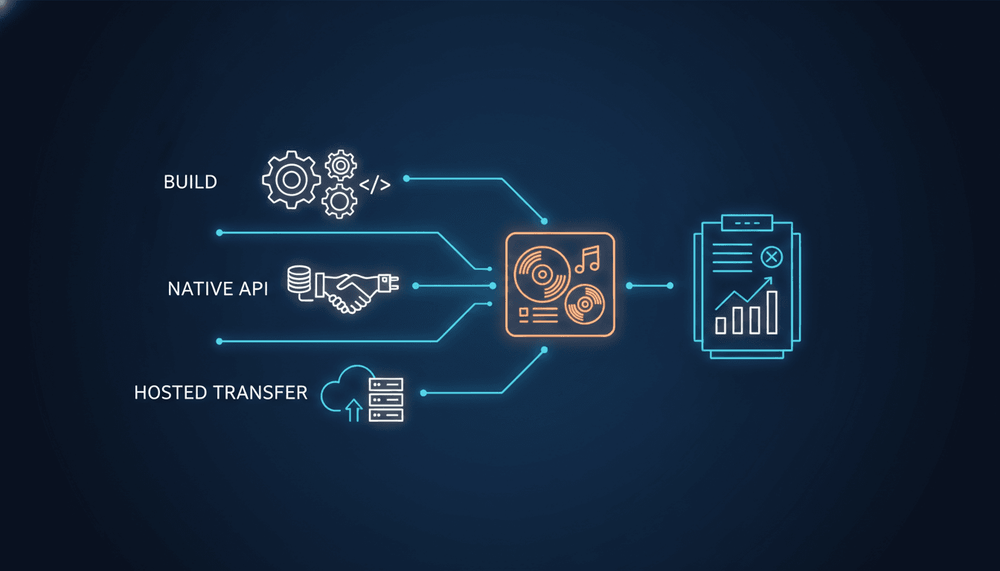
The playlist transfer build vs buy decision starts with two questions: which parts of onboarding must your team control, and which operational responsibilities can it fund after launch? Compare three approaches against the same transfer scope, then model initial engineering, monthly operations and request costs separately. A vendor invoice alone cannot answer the investment question.
For a CTO funding an onboarding import, the useful deliverable is a worksheet with named owners and explicit assumptions. The framework below supplies that structure. Its numerical scenarios illustrate billing arithmetic, not expected demand, engineering savings or a break-even point.
Compare an internal build, a native API integration and a hosted flow
Start with the responsibility boundary. Each approach leaves your team with a different implementation and maintenance budget.
| Decision area | Internal build | Native API integration | Hosted flow |
|---|---|---|---|
| Listener interface | Your team builds it | Your team builds it around the API | Your team adopts the supplied flow |
| Provider integration | Your team implements and maintains it | Evaluate the vendor's coverage | Evaluate coverage and destination configuration |
| Transfer behavior | Your team implements it | Divide responsibilities at the API boundary | Evaluate the supplied behavior |
| Application operations | Your team owns them | Your team owns its integration | Your team owns embedding and backend integration |
| Budget structure | Labor, infrastructure and operations | Integration labor, usage and retained operations | Configuration, usage and retained operations |
For a concrete comparison, MusicAPI Core provides REST endpoints and webhooks for a native transfer interface, with no SDK to install. MusicAPI Switch provides a hosted flow with fixed layout and sequence; customization covers logo, theme tokens and copy. The MusicAPI product overview quotes 2–4 engineering weeks for Core and about a day for Switch. Treat those as vendor estimates, not your delivery commitment.
Estimate security review, acceptance testing, analytics and rollout separately. Neither implementation estimate supplies your staffing cost or confirms that the experience meets your requirements.
Define the transfer scope before estimating engineering work
Write a one-page acceptance contract before asking engineers or vendors for estimates. Specify source services, destination, content types, library sizes and the listener's expected result.
“Import playlists” leaves too much room for incompatible estimates. Decide whether launch also includes albums, followed artists and liked songs. Describe how the interface should explain unmatched items, interrupted sessions and incomplete transfers. State whether the launch requires a custom selection screen or accepts a supplied sequence.
Use these questions to bound the estimate:
- Which source-to-destination combinations must pass acceptance testing?
- Which content types must arrive, and which can wait?
- What should happen when a listener reconnects or repeats an import?
- Which results must support staff see to investigate a complaint?
- What evidence will product accept before approving rollout?
Check service-specific operations in the supported features documentation before committing to a read or write requirement.
Establish integration scope before comparing competitor prices, too. Soundiiz distinguishes personal-account management through its User API from temporary import links through its Playlist Import API. Those descriptions establish different scopes, not equivalent onboarding architectures. See its developer documentation, checked September 18, 2026.
Use the existing playlist migration tool implementation guide for implementation planning. Keep this worksheet focused on funding and ownership.
Assign ownership for authentication, matching and transfer operations
Give every responsibility a technical owner and an escalation owner. A vendor can operate a component while your team still owns the listener's experience when that component needs attention.
Copy this matrix into the estimate. For each candidate, replace the questions with a named team, a documented vendor responsibility or an unresolved dependency.
| Workstream | Responsibility to assign | Acceptance evidence |
|---|---|---|
| Provider access | Who establishes access and tracks dependencies? | Confirmed launch scope |
| Authentication | Who maintains provider clients, refresh and reconnection? | Connection and recovery checks |
| Matching | Who operates matching and reviews exceptions? | Representative evaluation results |
| Transfer execution | Who handles throttling and partial failures? | Recovery acceptance cases |
| Monitoring | Who receives events and investigates stalled work? | Alert and escalation walkthrough |
| Listener support | Who explains missing items and next steps? | Support procedure |
| Change management | Who validates changes after launch? | Regression checklist |
| Exit | Who replaces the integration and removes dependencies? | Replacement work estimate |
MusicAPI handles provider OAuth clients, token refresh, scope changes and revocations. Its matching uses ISRC first, then a fuzzy resolver built on confirmed human corrections from FreeYourMusic. That assigns specific infrastructure work to the vendor; your team still needs acceptance criteria for the listener experience. The product overview describes these responsibilities.
For the hosted approach, include account enablement, destination configuration and webhook integration in your estimate. The transfer service documentation requires enablement and a configured destination before the flow starts. It also describes progress and results pages with match rates, unmatched items and CSV export.
Use the playlist transfer accuracy scorecard to define matching acceptance criteria. Keep that evaluation separate from the financial model so a cheap option cannot pass solely on cost.
Model 12-month costs with explicit labor and request assumptions
Create one worksheet tab per approach. Use the same scope and launch assumptions across all three.
For each workstream, enter initial hours, recurring monthly hours and a fully loaded hourly cost. Include engineering, design, QA, security and support where they contribute. Ask the responsible teams for estimates rather than applying a generic developer salary.
| Worksheet input | What to enter |
|---|---|
| Initial labor | Hours by role multiplied by each role's loaded cost |
| Maintenance labor | Monthly hours for changes, regression checks and dependencies |
| Operational labor | Monthly monitoring, incidents and listener support |
| Infrastructure | Monthly application, storage, queue and observability costs |
| Vendor usage | Monthly bill calculated from that month's requests |
| Other commitments | Applicable fixed charges from actual proposals |
| Exit contingency | A separately labeled estimate for replacing the approach |
Calculate the operating case as:
12-month cost = initial labor + one-time nonlabor costs + sum of monthly maintenance, operations, infrastructure and vendor charges.
Start the horizon at an explicit date. Record each month's production status rather than quietly assuming twelve identical billing months. Keep exit contingency visible beside the operating total; add it to an exit scenario instead of treating a hypothetical migration as certain spending.
For MusicAPI, the meter counts requests to streaming services on your behalf. Its cumulative monthly rates are EUR 0.60 per 1,000 for the first 5 million, EUR 0.45 for the next 20 million, and EUR 0.30 above 25 million. The EUR 500 monthly minimum starts with the first production call. Monthly invoices exclude VAT. See MusicAPI request pricing, checked September 18, 2026.
For a production month with R metered requests, calculate:
Usage charge = 0.00060 × min(R, 5,000,000) + 0.00045 × min(max(R − 5,000,000, 0), 20,000,000) + 0.00030 × max(R − 25,000,000, 0).
Monthly bill = max(EUR 500, usage charge).
Calculate each month separately. Applying a tier to annual volume would use the wrong billing period.
Keep the request forecast independent of the rate formula. Estimate monthly transfer starts, metered requests per transfer and any other applicable request activity. The pricing calculator assumes roughly 60 source requests plus 120 destination requests per transfer. Treat that as a planning assumption, then replace it with evidence for your architecture and library mix.
Test how volume and maintenance change the decision
Run low, base and high scenarios for both usage and retained labor. The table below uses illustrative monthly request totals. It does not forecast your traffic or compare total ownership costs.
| Illustrative scenario | Metered requests per month | Calculated monthly charge | Twelve identical production months |
|---|---|---|---|
| Low | 500,000 | EUR 500 | EUR 6,000 |
| Base | 6,000,000 | EUR 3,450 | EUR 41,400 |
| High | 30,000,000 | EUR 13,500 | EUR 162,000 |
These calculations apply the published rates and exclude VAT. At 6 million requests, the first bucket contributes EUR 3,000 and the remaining million contributes EUR 450. At 30 million, the three buckets contribute EUR 3,000, EUR 9,000 and EUR 1,500.
Next, vary maintenance independently. Ask each owner for routine-month and incident-heavy estimates. Include provider changes, regression work and support investigations without pretending that those events follow a known schedule.
Run at least three stresses:
- Launch delay: move the production start while retaining prelaunch labor.
- Larger libraries: increase requests per transfer without increasing listener count.
- Higher maintenance: increase retained engineering and support hours without changing volume.
Record which assumption changes the preferred option. If a small change reverses the result, gather evidence for that input before approving the budget. Do not publish a break-even claim until all approaches include comparable scope and costs.
Extend the same worksheet to 36 months when long-term ownership matters. Re-estimate maintenance and volume by year rather than multiplying the first-year total by three.
Choose an approach using UI constraints and engineering capacity
Apply decision gates before ranking totals.
UI gate: Reject a hosted candidate if mandatory onboarding requirements need a different layout or sequence. Branding flexibility cannot resolve a flow requirement.
Feasibility gate: Confirm access, required operations and destination readiness before accepting an estimate. Put unresolved dependencies on the launch schedule with an owner and decision date.
Capacity gate: Identify the team that will own transfer work after launch. Include the cost of diverting that team from other commitments, but avoid inventing lost revenue to make one option win.
Evidence gate: Require matching evaluation, recovery checks and an operational walkthrough for every candidate. Buying infrastructure changes responsibility boundaries; it does not remove acceptance testing.
Choose an internal build when control requirements and funded maintenance justify it. Choose a native API integration when your team needs UI ownership and wants a vendor to operate transfer infrastructure. Choose a hosted flow when its sequence fits and your team can own configuration and backend integration.
FAQ
How should procurement handle an uncertain exit date?
Keep exit costs in a separate scenario. Estimate replacement engineering, parallel operation, retesting and support preparation. Review those assumptions at renewal rather than assigning an unsupported probability to departure.
Can the sandbox validate the production volume model?
Use the sandbox for functional evaluation, not as evidence of production-scale performance. Signup creates an unmetered sandbox with no card requirement and five test listeners total across services. The MusicAPI overview states that cap. Build production volume estimates from your intended listener and library mix.
Bring your scope, ownership matrix and volume scenarios to the MusicAPI transfer service documentation. Evaluate the hosted flow against your onboarding requirements, then fund the integration and ongoing responsibilities explicitly.