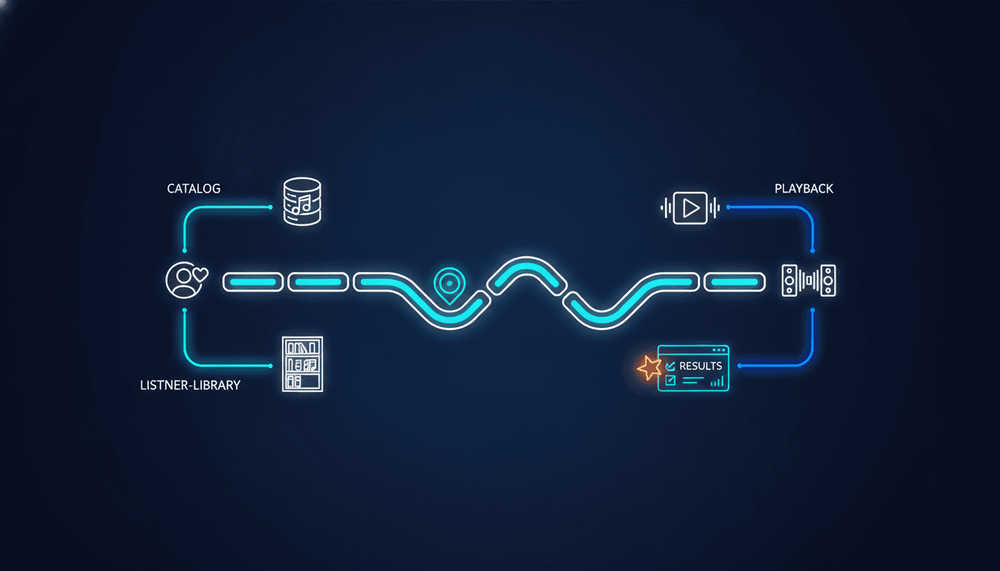
Choose music infrastructure by the operation your product must complete. A music streaming APIs comparison should separate catalog discovery, authenticated library reads, playlist writes, playback and cross-service transfers. For a cross-provider library feature, your shortlist must address both the source read and the destination write, plus the matching and reporting between them.
This comparison targets CTOs evaluating that shortlist. It uses primary documentation checked on September 25, 2026, and distinguishes direct provider capabilities from transfer infrastructure. Treat the matrix as a starting point for technical evaluation, then verify each required operation against your intended account, service and integration path.
Music streaming APIs comparison by product requirement
Start with a sentence that describes the listener's task: “Import my saved music,” “Create a playlist,” or “Play this track inside the app.” Those tasks require different evidence. Avoid giving every API a single score for “music support.”
| Product requirement | Relevant documented option | Evidence | Question to resolve before selection |
|---|---|---|---|
| Search a music catalog | Apple Music API | Apple documents catalog search across songs, albums, artists and playlists | Which catalog resources does your feature require? |
| Read or change listener collections | Provider library and playlist APIs | Apple documents authorized library and playlist operations; SoundCloud documents playlist retrieval and writes | Does your chosen integration expose every required read and write? |
| Insert a YouTube playlist item | YouTube Data API | Google documents POST /youtube/v3/playlistItems | Does this YouTube operation satisfy the actual listener task? |
| Reach a wider Spotify audience | Spotify's production access route | Spotify distinguishes Development Mode from Extended Quota Mode | Can your organization meet the access requirements? |
| Play audio inside your product | Provider playback integration | Apple documents MusicKit playback; SoundCloud documents widgets and stream access | What playback restrictions apply to the intended content and listener? |
| Move collections between services | MusicAPI transfer infrastructure | MusicAPI documents transfers across 12 supported services | Which source reads, destination writes and result details does your flow need? |
Sources: Apple MusicKit and Apple Music API, SoundCloud API guide, YouTube playlist insertion, Spotify quota modes and MusicAPI transfer infrastructure.
Read these rows as separate evaluation tracks. A documented playlist write proves that operation within its stated conditions. It does not establish source-library coverage, cross-service matching or permission to launch your entire product.
Keep direct provider access and intermediary coverage in separate columns of your own worksheet. Otherwise, a capability from one integration path can accidentally become a promise about another.
Compare catalog access and listener-library operations separately
Catalog access answers questions about music available through a service. Listener-library access answers questions about what a particular person has collected. Define both requirements explicitly, even when your interface presents them together.
Apple's documentation illustrates the distinction. It describes catalog search for songs, albums, artists and playlists. Separately, it describes authorized actions such as adding songs to favorites and creating or modifying playlists. Those statements describe Apple's direct API surface. They do not establish identical operations through every intermediary. See the Apple Music API overview.
For an onboarding import, write down the exact source objects you need: playlists, playlist contents, saved albums, followed artists or liked songs. Then specify the destination action for each object. Avoid treating “supports libraries” as a complete acceptance criterion.
SoundCloud provides a concrete example of why this detail matters. Its guide documents playlist creation through POST /playlists, with playlist metadata and track IDs. The request uses a playlist object containing fields such as title, sharing and tracks. Its collection pagination uses linked_partitioning=true and returns next_href for the next page. These details help define a real adapter contract. See the SoundCloud playlist and pagination documentation.
For a cross-provider evaluation, ask your team to demonstrate one complete sequence: enumerate a listener's selected collections, retrieve their contents, identify destination candidates and perform the intended write. Record gaps at each step instead of reporting one broad integration status.
Check the MusicAPI supported-features matrix separately when evaluating its integration path. Service coverage and operation coverage answer different questions. Verify the specific read or write before promising it in your product interface.
Verify developer access before committing to a provider
Evaluate access before scheduling the full implementation. Keep credentials for development, eligibility for a wider launch and endpoint permissions as separate checklist items. A working request in a developer account answers only part of the launch question.
Spotify makes this distinction explicit. Its quota documentation requires a Premium account for the owner of a Development Mode app. It also limits that mode to five authenticated users and requires developers to add those users to an allowlist. Spotify describes Extended Quota Mode as the route for apps that serve a wider audience. Review the Spotify quota-mode requirements.
Read change announcements together with their updates. Spotify's February 2026 announcement introduced Development Mode changes, but its March 9 update postponed endpoint-access changes for existing integrations. The update retained the Premium requirement, authorized-user cap and one-Client-ID limit for those integrations. Do not apply the original endpoint timeline to every existing app. See Spotify's developer-access announcement and update.
Quota evaluation also needs operation-level evidence. Google's documentation assigns 50 quota units to a YouTube playlistItems.insert call. It requires authorization and a part parameter, and identifies snippet.playlistId and snippet.resourceId as required request-body properties. That evidence concerns a YouTube playlist operation. It does not establish general YouTube Music library parity. See the YouTube playlist insertion reference.
Your access review should produce a short decision record: the account type you evaluated, the documented approval route, required permissions, relevant quotas and unanswered questions. Assign an owner to each unanswered question. Keep the candidate conditional until that owner resolves the launch dependency.
Distinguish playback integration from library transfer
Playback and transfer need separate acceptance tests. For playback, require the application to start the intended audio under the listener's actual conditions. For transfer, require the destination account to contain the intended collection and require the application to explain any omissions.
Apple describes MusicKit as a way to play Apple Music and a listener's local library from an app or website. SoundCloud documents playback through its widget or stream URLs, while also identifying content restrictions. Its guide distinguishes playable, preview and blocked access levels. Those playback details belong in a player evaluation, not in a blanket score for playlist portability. See Apple MusicKit and SoundCloud playback and restricted access.
When a requirement combines playback with import, split the proof into two demonstrations. First, show the collection reaching the destination. Then show playback through the intended player integration. Do not let a successful result in either demonstration substitute for the other.
For the transfer portion, MusicAPI moves playlists, albums, artists and liked songs between 12 supported services. It uses ISRC matching first, then a fuzzy resolver built on confirmed human corrections from FreeYourMusic. It reports unmatched and low-confidence items per item. This addresses the connection between reading one service's collection and finding its counterpart on another. See the MusicAPI transfer overview.
Keep your product wording equally precise. An “Import library” action should lead to an import result. A “Play” action needs a playback implementation. Review the existing music library import UX guide when deciding how your interface should communicate selection, progress and completion.
Evaluate matching and transfer-result requirements
Make matching quality an explicit evaluation category. Ask candidates to explain their matching approach and show how they expose uncertain results. Avoid accepting a single aggregate percentage without a definition of what it counts.
Build a representative evaluation collection with deliberately difficult examples: a studio recording beside a live version, a remaster beside an earlier release, similarly titled tracks and entries with incomplete metadata. These examples form a proposed test set, not a claim about any provider's performance.
For each example, decide what your product should accept before reviewing results. If a listener selected a live recording, should the importer substitute the studio version? Should the interface offer alternatives or leave the item unresolved? Product teams should own these decisions alongside engineering.
Keep matching and destination writes as separate outcomes. A candidate match answers which destination item the system selected. Your evaluation must also establish whether the intended destination action completed. Ask for evidence at both stages.
Use a result ledger with these evaluation categories:
- Source items selected for the transfer.
- Items that produced an acceptable destination match.
- Items that require review or lack an acceptable match.
- Destination actions that completed.
- Destination actions that need further investigation.
Treat this list as your acceptance model, not as an API response schema. Map each category to documented fields or demonstrated behavior during evaluation. Never invent vendor field names to make the worksheet look implementation-ready.
The existing guide to ISRCs, track IDs and cross-platform matching provides a related engineering reading path. Keep this comparison focused on selection criteria: what the resolver does, what evidence your team receives and what the listener sees when the system cannot confidently finish an item.
Turn the comparison into an integration shortlist
Choose candidates against a written acceptance contract. Give each required operation a source, destination, evidence link and owner. Mark the evidence as documentation reviewed, demonstration observed or test completed. Those labels describe different levels of confidence; do not collapse them into a single checkmark.
Use five gates for the shortlist:
- Access: Establish a viable route for the intended launch audience.
- Coverage: Verify every required source read and destination write.
- Matching: Define acceptable substitutions and review behavior.
- Results: Demonstrate how the product explains incomplete work.
- Commercial fit: Identify the billing unit and production minimum.
For a native transfer interface, MusicAPI Core provides REST endpoints and webhooks, with transfers running inside your own app and UI. You call plain HTTP from your chosen language; there is no SDK to install. MusicAPI Switch provides a hosted flow that you theme and embed, with fixed layout and flow. Choose between them according to your interface requirements. See the MusicAPI integration options.
For commercial comparison, use the actual meter rather than the number of buttons a listener presses. MusicAPI meters requests it makes to streaming services on your behalf. It invoices monthly, excluding VAT, and applies a EUR 500 monthly minimum from the first production call. Sandbox requests do not enter that meter. See MusicAPI usage pricing.
Keep engineering cost modeling outside this shortlist. Here, record the commercial assumptions and outstanding questions that affect selection. A detailed implementation estimate deserves its own analysis after you establish access and operational fit.
Finish with a proposed evaluation, not a universal winner. Name the listener task, selected service pair, required operations, acceptable matching behavior and evidence still missing. That decision record gives engineering and product a shared basis for approving the next step.
FAQ
How should we decide which service pair to evaluate first?
Choose a pair that exercises your launch-critical source objects and destination actions. Prefer evidence from your own intended audience when selecting it. If you lack that evidence, label the choice as an experiment and document the assumption. A convenient pair can help explore the workflow, but it should not silently define launch coverage.
What should we do when a required operation has no clear documentation?
Turn the gap into a specific question with a reproducible task: the source object, intended destination change, account conditions and expected result. Ask the provider or integration vendor to resolve it. Keep that operation outside the committed scope until your team has enough evidence to implement and verify it.
Who should own the comparison after we select an integration?
Assign an engineering owner for technical evidence and a product owner for listener-facing acceptance criteria. Revisit the decision when either the required workflow or the relevant documentation changes. Preserve the reasoning behind the choice so a later team can distinguish a deliberate tradeoff from an overlooked requirement.
Evaluate your onboarding import with the MusicAPI transfer-service documentation. The sandbox requires no card, does not meter requests and supports five test listeners in total across services. The EUR 500 monthly minimum starts with your first production call.