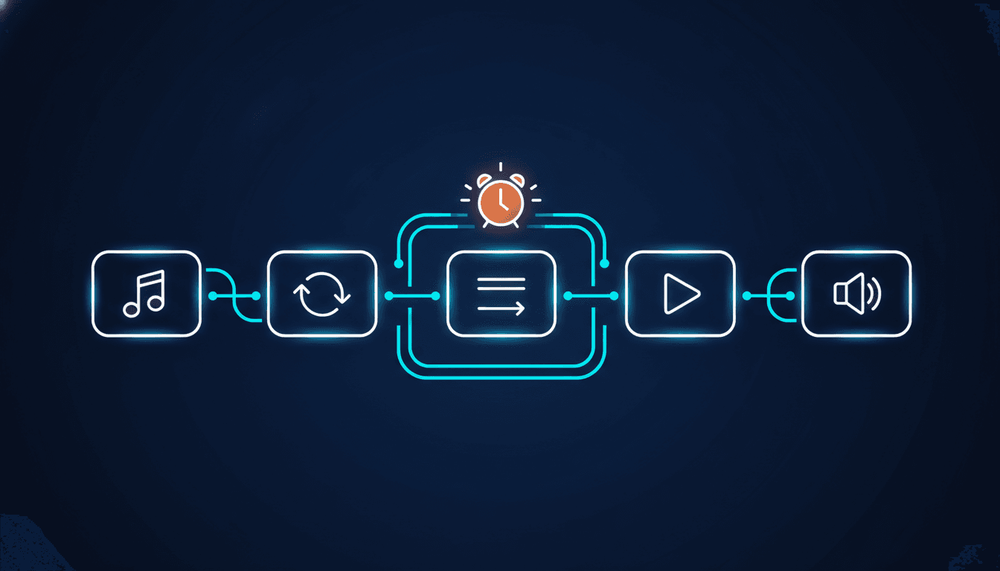
Playlist transfer time needs a workload model before it needs a countdown. For an onboarding import feature, estimate queue delay, source reads, matching, destination writes and retry waits separately. Then validate the whole completion window against transfers with comparable service directions, library sizes and concurrency.
A track count alone cannot answer when an import will finish. Your engineering team needs a worksheet that explains its assumptions, distinguishes processing from notification and shows where observations disagree with estimates. The model below supports customer-side planning. It does not describe MusicAPI's internal scheduling or promise a transfer latency.
Playlist transfer time depends on the work, not just the track count
Start by defining the clock. A listener experiences account connection, content selection, processing and the arrival of results. Your backend may observe only some of those boundaries. Record them separately instead of calling every interval “transfer time.”
For the processing estimate, start when the listener confirms the import. End when the transfer reaches a terminal outcome. Keep successful completion, completion with item exceptions and failure in separate outcome groups.
For the listener-facing measurement, start earlier, when the listener enters the import flow. End when your interface presents the result. This includes human interaction and notification delay, so it answers a different question.
Even consumer guidance covers broad windows. Apple's playlist transfer guidance, checked on October 2, 2026, describes minutes to hours for its Apple Music to YouTube Music flow. That range describes Apple's process; it supplies no benchmark for your import feature.
Compare workloads using selected item count, playlist count, repeated tracks, content types and service direction. Preserve direction explicitly: source A to destination B belongs in a different group from the reverse journey.
Build a completion-time worksheet for your import feature
Use one worksheet per workload group. Define each stage's entry and exit conditions before collecting timings, so different engineers measure the same interval.
| Component | What to record | Planning question |
|---|---|---|
| Account connection | Flow entry, authorization completion, confirmation | How long does the listener spend before processing? |
| Queue delay | Confirmation to first processing work | How much time passes before work starts? |
| Source reads | Request count, pages, active elapsed time | What work discovers the selected content? |
| Matching | Items examined, active elapsed time | What work resolves destination candidates? |
| Destination writes | Write operations, active elapsed time | What work adds the resolved content? |
| Retry waits | Start, end, cause, affected stage | Which pauses extend completion? |
| Results notification | Terminal outcome to visible result | How much delay follows processing? |
Record concurrency alongside these values. Include both the number of transfers competing for resources and the allowed work within each transfer. An estimate without its concurrency assumptions cannot explain differences between a quiet test and a busy onboarding period.
Keep request counts and item counts in separate columns. A page read, candidate lookup and destination write represent different work. Do not assume one request per track or infer operation counts from a library total.
If you own the workers, instrument these boundaries directly. If a vendor exposes only lifecycle events, record those observations and mark internal stages as outside your visibility. Do not manufacture stage durations by dividing the total evenly.
For the implementation details behind source enumeration, use the existing music API pagination guide. This worksheet needs the resulting workload counts, without duplicating the pagination tutorial.
Model sequential work, overlapping stages and retry waits
For a strictly sequential design, add queue delay, active reading, active matching, active writing and non-overlapping waits. Keep notification delay outside that processing sum.
For a pipelined design, draw the dependencies first. A write needs its matching result, but another batch might continue reading while that write runs. Adding every stage's elapsed duration would count overlapping time more than once.
Estimate the critical path: the chain of dependent work that determines the finish time. Under ideal, steady pipeline conditions, the slowest stage constrains throughput. Startup, the final batches and shared-resource contention still need explicit treatment. Do not simply take the longest stage and declare the estimate complete.
Count a retry wait only once on that path. A pause on one request may overlap useful work elsewhere. A pause that blocks all downstream work extends the finish time directly. Record which case your implementation permits.
MusicAPI handles track matching with ISRC first, followed by a fuzzy resolver built on confirmed human corrections from FreeYourMusic. That removes the need to build that resolver yourself, but supplies no matching-duration constant for this worksheet.
Request limits also supply no transfer-speed constant. The documented MusicAPI rate limits allow 300 requests per minute by default on user endpoints for new accounts. That ceiling does not establish items per minute or hosted-transfer throughput. MusicAPI normalizes upstream throttling to HTTP 429 with a Retry-After header. Use those signals when implementing request retries; do not convert the endpoint limit into a guaranteed finish time.
Work through a hypothetical transfer estimate
Consider an invented workload of 2,000 selected items across 20 playlists. Assume both accounts already have authorization. The numbers below demonstrate arithmetic only. They represent no provider benchmark, MusicAPI measurement or recommended operating rate.
Assume this implementation runs stages sequentially and records active stage time separately from retry waits:
| Component | Hypothetical assumption | Contribution |
|---|---|---|
| Queue | Work starts after confirmation | 12 seconds |
| Source reads | 40 operations at 0.5 seconds each | 20 seconds |
| Matching | 2,000 items at 25 items per second | 80 seconds |
| Destination writes | 100 operations at 0.6 seconds each | 60 seconds |
| Retry waits | Two blocking waits of 15 seconds | 30 seconds |
| Notification | Result display follows processing | 3 seconds |
The processing estimate equals 12 + 20 + 80 + 60 + 30, or 202 seconds. Adding notification produces 205 seconds from confirmation to visible results. Account connection and selection remain outside both figures.
Now change one assumption: matching runs at 12.5 items per second. Matching takes 160 seconds, so processing reaches 282 seconds and visible results arrive after 285 seconds. This sensitivity check identifies matching as a useful measurement target in this invented model.
If you pipeline the stages, neither total remains valid automatically. You need batch boundaries, dependencies and a schedule to calculate the overlap. The worksheet should retain the sequential calculation as a reference, then replace it with the modeled timeline.
Neither estimate establishes a percentile. A conservative assumption does not become a p95 just because it produces a larger number. Only observations from a defined population can support that label.
Calibrate completion windows by service direction and library size
Create separate measurement groups for each source-to-destination direction and library-size band. Add playlist count or content mix when those differences explain residual error. Avoid splitting groups so narrowly that a handful of transfers determines the published window.
Store the estimate at confirmation time. Compare that original forecast with the eventual duration, rather than quietly replacing it with a better estimate after the transfer finishes.
The following calibration table contains synthetic observations solely to illustrate the format. A and B represent fictional services. These values describe no real integration.
| Direction and selected items | Sample count | Initial estimate | Observed p50 | Observed p95 | p95 minus estimate |
|---|---|---|---|---|---|
| A → B, 1–500 | 240 | 50 s | 44 s | 91 s | +41 s |
| A → B, 501–2,000 | 180 | 202 s | 188 s | 330 s | +128 s |
| B → A, 501–2,000 | 160 | 230 s | 216 s | 410 s | +180 s |
For real measurements, record the observation period, model version, concurrency conditions and outcome filters beside the table. The p50 describes the middle observation; the p95 describes a duration at or below which roughly 95% of that cohort completed.
Do not hide unsuccessful attempts. Report their frequency separately, and keep ongoing transfers visible in the evaluation. Selecting only transfers that finished quickly during a short observation window can distort the result.
Separate processing completion from webhook receipt and results display. MusicAPI uses webhooks to notify your backend about transfer state changes. Record your receipt time, but do not treat it as a precise internal completion timestamp without an established timing definition.
Where stage visibility ends, say so in the worksheet. You can calibrate an end-to-end window without claiming access to internal queue or matching telemetry.
Use measured completion windows in your build-versus-buy decision
Evaluate ownership and timing together. Ask who measures each boundary, investigates slow cohorts and updates the listener-facing window. Include that work in the decision alongside the transfer implementation itself.
Use the playlist transfer build-versus-buy framework for the broader ownership analysis. Here, compare candidates using the same workload definition, start boundary, terminal outcomes and concurrency assumptions. Require evidence for any quoted completion window.
Keep billing arithmetic separate. MusicAPI pricing meters requests to streaming services on your behalf. A monthly request total supports a cost calculation, but it contains no schedule, overlap or waiting-time information. It cannot establish elapsed transfer time.
Choose listener-facing wording from the measured cohort and explain what happens beyond the expected window. The music library import UX guide covers that interface design. Keep this article's worksheet focused on the evidence behind the estimate.
FAQ
Should a repeat import share the first-import timing cohort?
Initially, separate them. Record how much work each run actually performs, then combine cohorts only if your measurements justify it. A repeated selection does not necessarily create the same processing workload.
When should we recalibrate the worksheet?
Recheck after changes to batching, concurrency, matching, retry behavior or the mix of service directions. Also monitor forecast error during normal operation. Set your own review threshold before collecting results, so a missed expectation triggers investigation consistently.
To evaluate an onboarding import, start with the MusicAPI transfer service documentation and use this worksheet to define your completion-time acceptance criteria.